


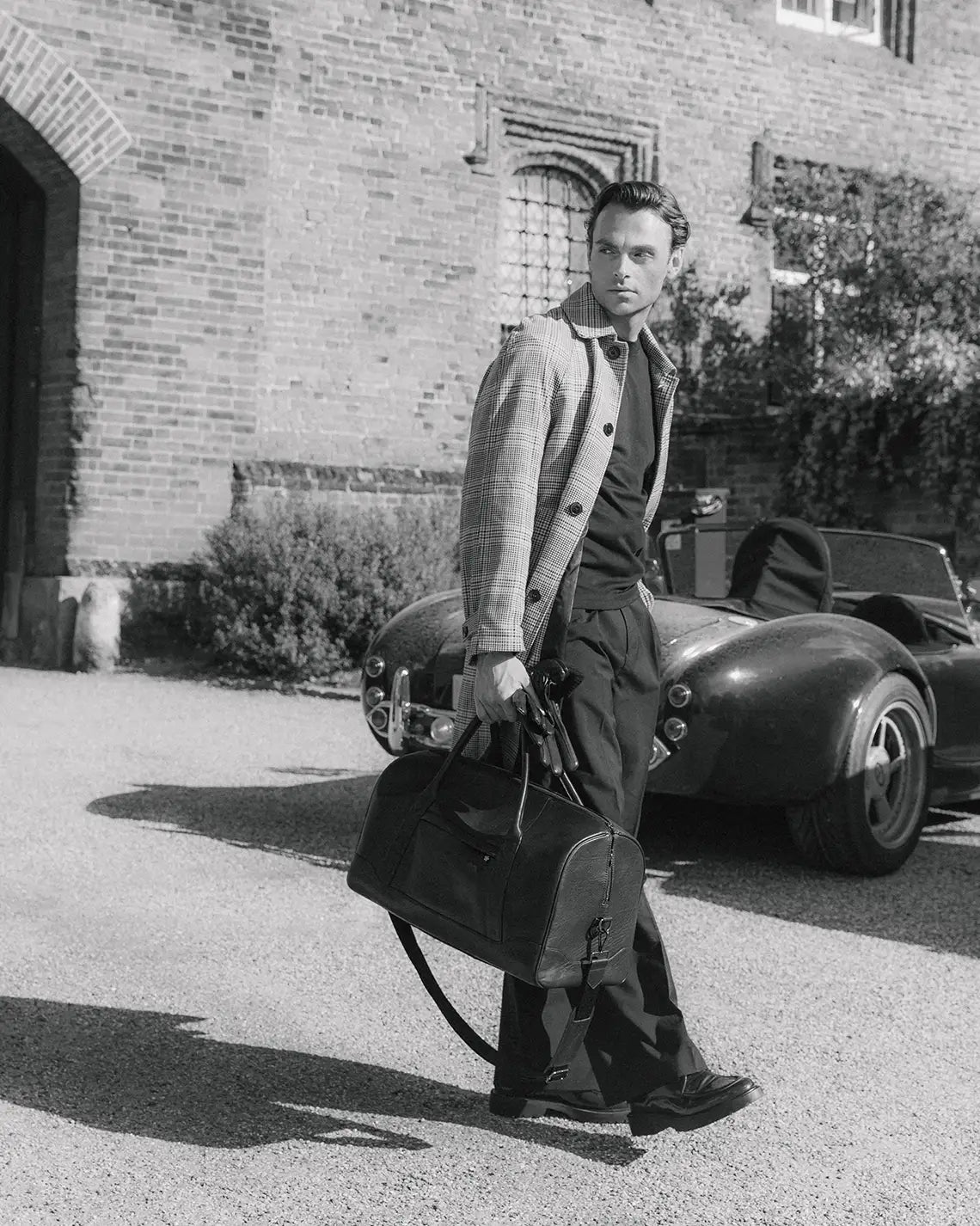


Owner, CEO and Creative Director of RHANDERS, Rina Hansen, has written the book’s personal afterword. With a PhD in the digitalisation of heritage brands and a career in international luxury fashion, she reflects on calling, responsibility and what it means to be entrusted with 800 years of history – and one day pass it on.

A glove is a small object. And yet, somehow, it has taken up an extraordinary space in my life.
I have known RHANDERS since my childhood. My grandmother, who worked in fashion, spoke of the brand with a certain reverence. I sensed it embodied something exceptional, long before I understood exactly why.
Years later, while I was living in London, my hairdresser Thomas, who would later become my husband, sent me an article by the Danish journalist Hanne Sindbæk about RHANDERS. I remember seeing the company differently for the first time. Suddenly, what my grandmother had expressed, the unique fairytale aura surrounding the brand, and everything I had learned through my own career in international luxury fashion came together. I could see what was there, but perhaps even more clearly, I could see what it could become.
Something in me responded. Not really as a business idea or even a plan, but more like a calling – quiet, persistent and strangely difficult to ignore. Rationally, it made very little sense. I lived in London, had a promising international career and had never even been to Randers. And yet the feeling kept returning.
It took eleven years before RHANDERS finally became ours. In those eleven years, an entire life unfolded. Thomas and I married, I moved back to Denmark, our twin daughters were born, careers grew, a PhD was completed, a company was founded, and eventually we moved to Randers to be closer to the dream that simply refused to disappear.
Life kept offering perfectly good reasons to let it go. Nevertheless, the dream remained.
When I finally held the keys to RHANDERS in my hands, I thought I had spent eleven years trying to acquire a company. Only later did I begin to understand that perhaps it was the other way around. Perhaps we never really bought RHANDERS. Instead, we were simply entrusted to serve it.
Because you cannot buy and own 800 years of heritage. You can only look after it. Or, in other words, you have a cultural responsibility, just as you have a social responsibility, as Anne Sophia Hermansen told me at the time.
SOMETHING ENTRUSTED
What does it mean to own something that began long before you were born and, if all goes well, will continue long after you are gone?
You can own buildings, patterns, an archive and the name. But you cannot really own the knowledge in another person’s hands. A movement perfected through decades. A seam learned from someone who learned it from someone before her. The instinct to know how a skin will behave before the knife ever touches it.
When we took over RHANDERS, this became very real to me. The history was not only in the archive. It was alive around us, in the tools still being used, patterns still being cut and people carrying knowledge that had never been written down.
I found the same sense of belonging in the stories our customers shared with me. All my grandchildren receive a pair of driving gloves when they get their driving licence. I feel closer to my father when I wear the police gloves. I feel my mother’s touch when I touch a glove from RHANDERS. These were not simply stories about products. They were stories about people, memory and belonging. Through them, I began to understand that RHANDERS did not belong to me.
It changed my understanding of ownership, leadership and cultural heritage itself. We need deep roots as human beings. Something lasting. Something that connects us to those who came before us and to something larger than ourselves.
THE WORK OF THE HAND
The hand is our most fundamental tool – a place of sensation, creation, decision and connection. It is where heart and mind can find expression in the physical world.
Perhaps this is what has fascinated me most about craftsmanship. It is not simply a way of making things. It is a deeply human practice.
At RHANDERS, knowledge has travelled this way for generations: from hand to hand. Some of the most important knowledge in our atelier cannot be fully captured in a manual or drawing. It lives in trained eyes, small corrections and movements repeated until they become almost instinctive. A trained hand senses what cannot always be measured. It knows when to cut, when to adjust and when something is right. Or, as one of our seamstresses says, you have to stop thinking and let the hands do their work.
Through the hand, knowledge becomes movement, intention becomes form, and an idea becomes something another human being can touch. This, to me, is the magic of the hand.
Reestablishing production in Denmark has therefore been one of my biggest dreams – and one of the most difficult tasks. I had no idea where to start. But one day, I shared my dream on a radio programme. The next day, as if some dreams really do call people towards them, three former RHANDERS seamstresses knocked on the atelier door.
I may have felt the calling, but I could never have answered it alone. RHANDERS is carried by a team of people who bring their hands, minds and hearts to work every day. Some carry knowledge passed down through generations; others bring new skills, perspectives and ideas. Together, across the atelier, design studio, stores and digital world, we challenge each other, learn from each other and keep the heritage alive.
But keeping this knowledge alive in Denmark is increasingly difficult. We are no longer a manufacturing country in the way we once were, and much of the ecosystem surrounding specialised craft has disappeared. Mastery takes years of repetition and refinement, until knowledge moves from the mind into the hands.
We have indeed trained young craftspeople for three years each, only to watch them leave again to explore the world. I understand that desire completely – I explored the world myself. But it has shown me how fragile the transmission of craft can be.
Other cultures have found inspiring ways of protecting this continuity. Japan supports masters of traditional crafts and the training of successors, while France and Italy have created structures around heritage houses, métiers d’art and manufacturing traditions. They recognise something I have come to understand deeply: craftsmanship is not only a way of producing things. It is culture.
For a small company like RHANDERS, we have often felt remarkably alone in carrying that responsibility. Perhaps that has also made our determination stronger.
A LIVING HERITAGE
Keeping a tradition alive does not mean keeping it still. From the beginning, I kept saying: We shall not become a working museum. We shall preserve craft through evolution and create objects of desire for today.
Heritage does not come from simply being old. It comes from knowing how to sway – between continuity and evolution. Some traditions need to remain traditions. Others need to evolve to stay meaningful today and thereby survive tomorrow. The art lies in knowing what to preserve and what to allow to change.
The Anna glove is a brilliant example. Traced back to a pattern from the 1830s, it has remained a bestseller for around a century – not because it is old, but because it is still beautiful, useful and desirable today.
Things should be given life, and when they show signs of that life, we should be able to care for them and repair them. Wear becomes part of the story rather than the end of it.
A NEW LANGUAGE FOR SOMETHING ANCIENT
One of the great joys of taking on RHANDERS has been reviving the archives: returning to original patterns and centuries-old craftsmanship methods and exploring how they can be given new life today. A glove pattern can inspire the cut of a jacket. Traditional construction methods can find new expression in coats and shearlings. An ancient quilting technique can transform butter-soft glove leather into a modern bag.
The glove remains at the heart of RHANDERS. It is where our craftsmanship and design language were born. But today, that language travels from gloves into jackets, coats, shearlings, bags and accessories, forming a complete luxury house.
The Kalmus flower is the magical mark of it all. Its distinctive scent has travelled with our gloves for centuries and still fills the RHANDERS universe today – a living symbol carried into every RHANDERS design.
My professional and academic life has been shaped by international fashion and digitalisation of heritage brands. But over time, I have witnessed how a heritage luxury house today requires far more than preserving craft. We have to be makers, but we also have to be storytellers. Online, we increasingly act as a media brand, translating centuries of history, craftsmanship and imagination into films, images and stories that can travel across the world. In our stores, we must create more than places to buy. Through talks, exhibitions, events and encounters with the craft, retail becomes a place of experience, discovery and entertainment.
A glove maker alone won’t cut it in today’s world. It takes craftspeople, designers, storytellers, photographers, digital and data minds, retail and service teams – an entire ecosystem – to make an 800-year-old heritage meaningful today.
Our materials remind us of another responsibility. Leather, wool, cotton and silk all begin in living systems. Working with natural materials reminds us that making begins with what nature gives us – and with our responsibility to use it with care.
Caring for a forest near Randers has taught me something similar. A forest, like a Kalmus plant, refuses impatience. It grows according to rhythms we do not control and asks us to care for something whose full outcome we may never see ourselves. In that sense, it is surprisingly close to craftsmanship.
Through all of this, I have learned that carrying a heritage company forward is not about glorifying the past. It is about understanding what is worth preserving – and finding a new cultural language that allows it to matter today.
THE BOOK IN YOUR HANDS
When we took over RHANDERS, almost none of its history had been written down or documented. We knew RHANDERS was important. I had sensed it since childhood. But we still did not fully understand why.
When the company finally became ours, I sent Hanne Sindbæk a bouquet of flowers to thank her for the article that had inspired us to carry this important piece of Danish cultural heritage forward. And when Hanne and I met in August 2019, we returned to the question that had followed me from the beginning: What was it about RHANDERS that made it feel so important? We decided to find out.
We began tracing the stories, the people, the objects and the craft; documenting what until then had largely lived in memories, archives, museums, libraries and hands. We wanted to create the book I wish had existed when I first held the keys to RHANDERS – something that could help us understand what had been entrusted to us, and one day help us entrust it to someone else.
Today, seven years later, you are holding that book in your hands.
PASSING IT ON
I don’t know what RHANDERS will look like one hundred years from now. And I have come to realise that I am not supposed to know. Our task is to leave the next generation something alive, strong and meaningful – something they can take somewhere we cannot yet imagine.
Above all, I hope there will still be hands teaching hands.
And I hope this book might inspire someone, somewhere, to carry another heritage company forward – or to support someone with the courage to do so. I believe we will need these deep wells of human creativity, knowledge, craft and cultural history more than ever in the times to come.
And if something feels worth carrying forward, begin. Remember: “Whatever you can do, or dream you can, begin it. Boldness has genius, power and magic in it.” As Goethe allegedly said.
For a little while, this courageous task is ours. And then we must open our hands and pass it on. Perhaps that is what I did not understand all those years ago in London. I thought I had found a company I wanted to own. Instead, I had found a small object carrying a much larger story – one I was called to serve.
Rina Hansen
Discover more about the Coffee Table Book The Art of Glovemaking since 1684
and the Danish literary edition RHANDERS: Danish design since 1684.
Join the book launch events
